Table of Contents
ToggleLatest Update – November 2026
The IRS continues to require eligible businesses to submit Form 2553 to elect S corporation tax treatment. Businesses planning to change their federal tax classification should review the current IRS filing instructions, eligibility requirements, and late-election relief provisions before submitting the form.

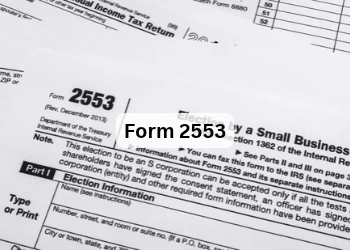
Form 2553 is an IRS document that eligible businesses use to elect S corporation tax treatment under Section 1362(a) of the Internal Revenue Code. To make the election effective for a particular tax year, businesses generally must file the form within two months and 15 days after the beginning of that year or during the preceding tax year.
Key Facts at a Glance
- Form 2553 is used to elect S corporation tax treatment
- Eligible businesses must generally have no more than 100 shareholders.
- All shareholders must provide the required consent.
- The standard filing deadline is two months and 15 days after the beginning of the tax year.
- Certain businesses may qualify for late-election relief under IRS Revenue Procedure 2013-30.
Quick Read
This guide is for business owners, entrepreneurs, and accounting professionals considering S corporation taxation. It explains what Form 2553 does, who qualifies, when to file, and how to complete the required information. It also covers late-election relief, common filing mistakes, and the importance of maintaining accurate tax records throughout the election process.
Introduction
Choosing the right federal tax classification can influence how a business reports income, handles shareholder distributions, and manages its tax obligations. For eligible businesses, electing S corporation status may provide a different tax treatment from the default classification.
The IRS requires eligible corporations and certain other entities to file Form 2553 to make this election. However, completing the document involves more than entering basic business information. Owners must satisfy specific eligibility requirements, obtain shareholder consent, select an appropriate effective date, and meet the applicable filing deadline.
Understanding the Form 2553 instructions before submission can help businesses avoid processing delays and problems with their intended tax classification. This guide explains the filing process, important requirements, and steps to take if an election is submitted late.
What Is Form 2553 and Why Does Your Business Need It?
Form 2553, officially called Election by a Small Business Corporation, is an IRS form used by eligible businesses to elect taxation under Subchapter S of the Internal Revenue Code.
An S corporation is generally a pass-through tax entity. Instead of paying federal income tax at the corporate level on most business income, the corporation’s income, deductions, credits, and other tax items generally pass through to its shareholders, who report their respective shares on their individual tax returns.
However, an S corporation is still a legal corporation or eligible entity. The election changes its federal tax treatment; it does not automatically change its legal structure.
How Does S Corporation Taxation Work?
Under the S corporation structure, business income generally passes through to shareholders in proportion to their ownership interests.
For example, consider a business with two shareholders who own 60% and 40% of the company. If the business generates $200,000 in pass-through income, the shareholders generally report $120,000 and $80,000, respectively, subject to applicable tax rules and adjustments.
An S corporation must also comply with payroll and reasonable compensation requirements when shareholder-employees perform services for the business. Shareholders who work in the business generally must receive reasonable compensation before non-wage distributions are made.
This distinction is important because S corporation status does not mean that all business income can automatically be withdrawn as tax-free distributions.
Is Form 2553 the Same as Form 1120-S?
No. These documents serve different purposes.
|
Form
|
Primary purpose
|
|---|---|
|
Form 2553
|
Elects S corporation tax treatment.
|
|
Form 1120-S
|
Reports the annual income, deductions, gains, losses, and other tax information of an S corporation.
|
|
Form 8832
|
Allows an eligible entity to elect its federal tax classification.
|
An eligible entity that qualifies for S corporation treatment generally does not need to file Form 8832 separately when Form 2553 is properly filed and the relevant requirements are met.
You can also read – Onshore vs. Offshore Outsourcing for 1120S Filings: Pros, Cons & Security Compared
Who Is Eligible to Elect S Corporation Status Using Form 2553?
Not every business can elect S corporation status. The IRS imposes specific requirements relating to the company’s domestic status, shareholder composition, ownership structure, and tax year. Before preparing an election, business owners should confirm that the entity satisfies these conditions.
The Business Must Be a Domestic Entity
The business must be a domestic corporation or an eligible domestic entity that can elect to be treated as a corporation for federal tax purposes. Certain LLCs may qualify. However, an LLC does not automatically become an S corporation simply because its owners prefer that tax treatment.
The Business Cannot Have More Than 100 Shareholders
An S corporation generally cannot have more than 100 shareholders. Certain family members and their estates may be treated as one shareholder for this test under specific IRS rules.
Shareholders Must Meet Eligibility Requirement
Permitted shareholders generally include individuals, certain trusts, and estates. The following are generally ineligible shareholders:
- Nonresident alien individuals.
- Partnerships.
- Corporations.
- Certain trusts that do not qualify under S corporation rules.
The Business Must Have Only One Class of Stock
An S corporation can have only one class of stock for federal tax purposes. However, differences in voting rights are permitted. The business must also satisfy the applicable requirements concerning outstanding shares and economic rights to distributions and liquidation proceeds.
The Business Must Meet Tax Year Requirements
An S corporation generally must use a calendar year ending December 31 unless it qualifies for another permitted tax year under IRS rules. These may include a natural business year, an ownership tax year, or a tax year supported by a valid business purpose or other applicable election. Certain financial institutions, insurance companies, and domestic international sales corporations are also excluded from S corporation eligibility. Businesses should review all these conditions before submitting the Form 2553 S Corp election. A filing alone cannot make an otherwise ineligible entity qualify.
When Should You File Form 2553 to Meet the IRS Deadline?
The filing deadline depends on when the business wants its S corporation election to become effective. Generally, a business must submit Form 2553:
- No later than two months and 15 days after the beginning of the tax year in which the election is intended to take effect.
- At any time during the tax year preceding the year in which the election is intended to take effect.
For a calendar-year business seeking S corporation treatment beginning January 1, the standard deadline is March 15 of that year.
Form 2553 Filing Deadline: Practical Examples
|
Situation
|
Filing Deadline
|
|---|---|
|
Existing calendar-year business electing S status for 2027
|
March 15, 2027
|
|
Existing calendar-year business electing S status for 2028
|
Any time during 2027 or by March 15, 2028
|
|
Newly formed business beginning its first tax year on January 7
|
Generally March 21 for an election effective from January 7
|
The deadline for a new business may differ depending on its actual first tax year and the date it begins operating or acquires shareholders or assets.
Why Should Businesses File Early?
Submitting the election early gives the business time to address missing information, incorrect shareholder details, or signature issues. It also allows accounting teams to coordinate the effective date with payroll setup, bookkeeping procedures, estimated tax payments, and annual tax return preparation. Businesses should retain proof of submission and monitor the IRS acknowledgment. If the IRS does not communicate acceptance or nonacceptance within the applicable processing period, the business should follow up.
How Do You Complete and Submit Form 2553 Correctly?
The IRS Form 2553 instructions explain the information required in each section. Businesses should gather the relevant corporate, ownership, and tax information before beginning the filing process. The current IRS form is available as a downloadable PDF, which can be completed electronically using a compatible PDF application and then printed for submission.
-
Enter the Business Information Part I begins with the company's basic details, including:
- Legal business name and mailing address.
- Employer Identification Number (EIN).
- Date and state of incorporation or organization.
- Effective date of the S corporation election.
- Selected tax year.
-
Select the Effective Date The effective date determines when the S corporation election begins. For an existing business, this will generally be the first day of the tax year for which the election is intended. For a business making the election for its first tax year, the IRS instructions specify how to determine the appropriate beginning date. Entering an incorrect effective date can affect the intended tax treatment and filing obligations.
-
Provide Shareholder Information and Obtain Consent The business must provide the required shareholder details in Part I. This includes shareholder names, addresses, ownership information, dates of ownership, and other requested details. Each shareholder must consent to the election by signing the appropriate shareholder consent statement. Missing signatures can make the election invalid or affect its timely filing.
-
Complete Additional Sections Where Applicable Part II addresses certain fiscal tax year elections and related requirements. Part III is used for certain Qualified Subchapter S Trust (QSST) elections where applicable. Part IV contains representations relevant to certain late corporate classification and S corporation elections. Not every business needs to complete all these sections. The applicable requirements depend on the entity's circumstances and the nature of its election.
-
Sign and Submit the Form An authorized corporate officer must sign and date the election. The form can generally be submitted by fax or mail to the appropriate IRS service center. The correct filing address or fax number depends on the location of the business's principal office, and businesses should verify current IRS submission details before filing. Keep a copy of the completed election and proof of delivery or fax transmission with the company's permanent records. The IRS generally notifies the business whether its election has been accepted. If no notification is received within two months, the business should contact the IRS to follow up.
What Happens If You Miss the Form 2553 Filing Deadline?
Missing the filing deadline does not necessarily mean a business has permanently lost the opportunity to elect S corporation status. The IRS provides late-election relief under Revenue Procedure 2013-30 for certain businesses that meet specific conditions. However, relief is not automatic. The business must demonstrate that it intended to elect S corporation status and that its failure to file on time occurred for a reasonable cause.
Understanding Late-Election Relief
A business may qualify for relief if it meets the applicable requirements, including:
- It intended to be treated as an S corporation from the requested effective date.
- It failed to qualify solely because the election was not filed on time.
- It has reasonable cause for the filing delay and acted diligently after discovering the mistake.
- It meets the applicable time limit, generally three years and 75 days from the intended effective date.
- The shareholders reported their income consistently with the intended S corporation election for the relevant years.
Special provisions also exist for certain corporations that fall outside the general three-year-and-75-day period.
When seeking relief, the business must provide the required reasonable-cause explanation and shareholder statements. The form must also include the appropriate late-election notation specified by the IRS.
If the business does not qualify for relief under Revenue Procedure 2013-30, it may need to request a private letter ruling.
Common Form 2553 Filing Mistakes to Avoid
Several administrative errors can delay or complicate the election process.
|
Common mistake
|
Why it matters
|
|---|---|
|
Missing the filing deadline
|
The intended election may not take effect.
|
|
Incorrect effective date
|
The requested tax treatment may be affected.
|
|
Missing shareholder signatures
|
Required shareholder consent may be incomplete.
|
|
Incorrect EIN or legal name
|
The IRS may have difficulty matching the election to business records.
|
|
Ineligible shareholder
|
The business may fail S corporation eligibility requirements.
|
|
Incorrect stock information
|
The business may not satisfy the one-class-of-stock requirement.
|
|
Failure to retain filing proof
|
It becomes harder to establish when the election was submitted.
|
Reviewing the completed form before submission can help prevent avoidable errors and administrative complications.
How Can KMK Associates Help
KMK Associates provides accounting and tax preparation support to accounting firms and businesses that need dependable financial documentation and consistent accounting workflows. S corporation reporting requires accurate bookkeeping, properly maintained shareholder records, and reliable financial information.
Our accounting professionals assist with account reconciliations, financial statement preparation, transaction documentation, and tax preparation support. These activities help accounting teams maintain organized records for preparing Form 1120-S and supporting shareholder reporting requirements.
Through structured workflows, technology-enabled processes, and appropriate quality reviews, KMK helps improve reporting consistency and operational efficiency. Our outsourcing tax preparation support can also help accounting firms manage seasonal workloads without compromising their internal review and approval responsibilities.
Whether supporting routine bookkeeping or recurring tax preparation requirements, KMK provides scalable accounting assistance that complements the work of CPAs and tax professionals.
Need Help Managing S Corporation Tax Preparation and Accounting Records?
Professional support helps improve documentation, accuracy, and tax preparation efficiency.
Conclusion
Electing S corporation status can influence how a business reports its income and manages its federal tax obligations. However, the process requires careful attention to eligibility requirements, shareholder consent, effective dates, and filing deadlines.
Understanding how to complete and submit Form 2553 correctly can help businesses avoid unnecessary delays and maintain the intended tax classification. Owners should also recognize that an S corporation election brings continuing responsibilities, including annual tax returns, payroll compliance where applicable, and accurate shareholder reporting.
Reviewing the election with a qualified tax professional before submission can help ensure that the business meets the requirements and understands its ongoing obligations.
FAQs about Form 2553
Form 2553 is used by eligible businesses to elect S corporation tax treatment under Section 1362(a) of the Internal Revenue Code. The election allows qualifying business income and other tax items to generally pass through to shareholders rather than being taxed at the corporate level.
Yes. An eligible LLC can generally elect S corporation tax treatment by filing Form 2553. If it meets the applicable requirements, a separate Form 8832 election is generally unnecessary. The LLC retains its legal structure while changing its federal tax classification.
Generally, Form 2553 must be filed within two months and 15 days after the beginning of the tax year in which the election is intended to take effect. Businesses can also file during the preceding tax year to make the election effective for the following year.
Yes, certain businesses may qualify for late-election relief under IRS Revenue Procedure 2013-30. They generally need to demonstrate reasonable cause, consistent tax reporting, shareholder consent, and compliance with the applicable time limits. Relief is subject to specific eligibility conditions.
No. Form 2553 only establishes the requested S corporation tax election when properly accepted. The business must continue meeting its tax and reporting obligations, including filing Form 1120-S, issuing shareholder Schedule K-1s, and complying with applicable payroll and estimated tax requirements.
What Next?
Need Help Managing Your S Corporation Accounting Requirements? Still have questions? That’s where KMK comes in. KMK Associates provides reliable accounting and tax preparation support to help businesses and accounting firms maintain accurate financial records, streamline reporting workflows, and manage recurring tax preparation requirements. Talk to an expert today!